
Every line on it
is there for a reason.
Unfolded it looks like an ordinary mat with a few lines on it. Those lines are the product — a built-in alignment system: two run the full length and two cross the ends, and between them they let you double the padding wherever a joint needs it while the rest of the mat stays flat.
Open, it is a full-length mat and nothing about it gets in your way. The lines are the only clue that it does anything else.
-
The fold-over flaps
The two lines across the ends mark the flaps. Fold one up and that end of the mat is instantly twice as thick — put it under your knees, your tailbone or your head without ever stepping off the mat.
-
Guide lines down the full length
Two lines run end to end. Square your hips and shoulders against them and you can see straight away when a pose has pulled you off centre — no mirror, nobody correcting you.
-
The sides fold in too
Those same lengthwise lines are folds. Bring an outer strip over the middle and you get a narrow, double-thick lane down the centre, which is what you want for kneeling work and forearm planks.
-
Nine placement sections
Where the lines cross they divide the mat into nine sections. Hands in one, feet in another, and your stance lands in the same place every time instead of drifting pose after pose.
-
Textured on both faces
The whole surface is a fine raised grid, top and bottom. It grips the floor and grips you, folded or flat, and wipes clean instead of soaking up sweat.
One mat,
four ways to save a joint.
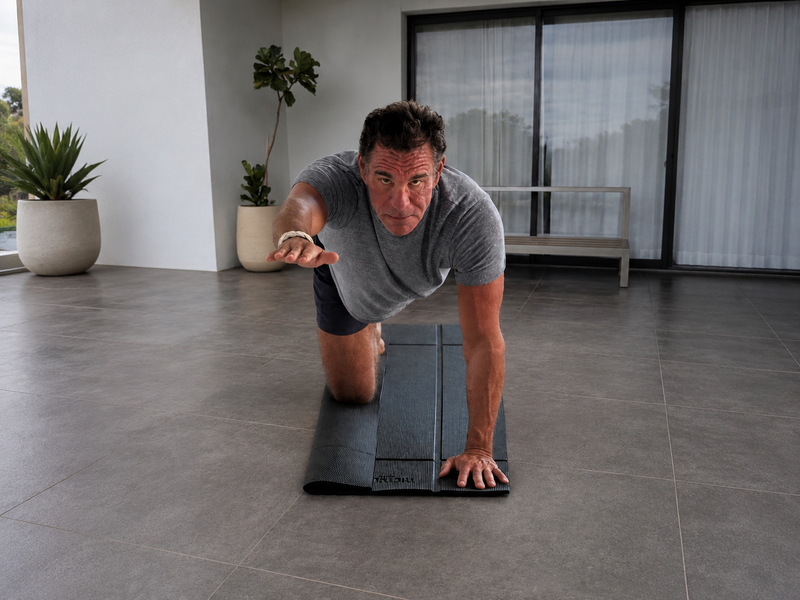
Fold it under your wrists
Fold an end flap up and rest your palms on the doubled edge. Plank, downward dog and chaturanga stop driving all your weight into the heel of the hand.
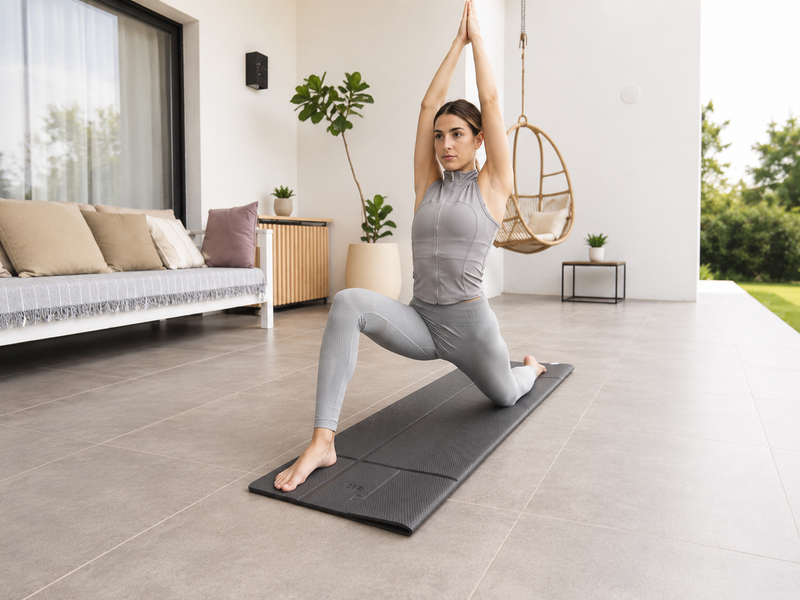
Fold it under your knees
The same end flap, moved under the knee. Low lunge, kneeling twists, anything with a kneecap on the floor — double thickness is the difference between holding the pose and cutting it short.
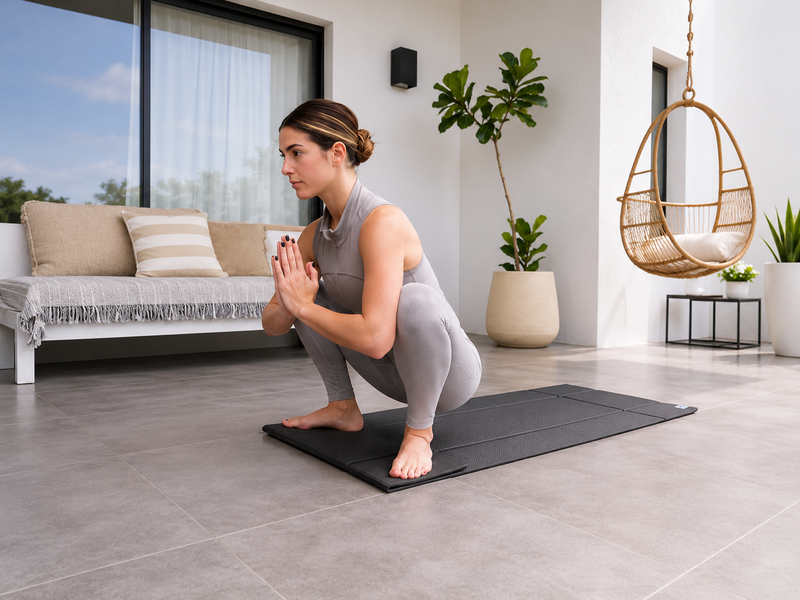
Fold it under your elbows
Fold one of the long sides over the middle and you get a narrow double-thick lane. Forearm planks and dolphin land on it instead of on a joint with no padding of its own.
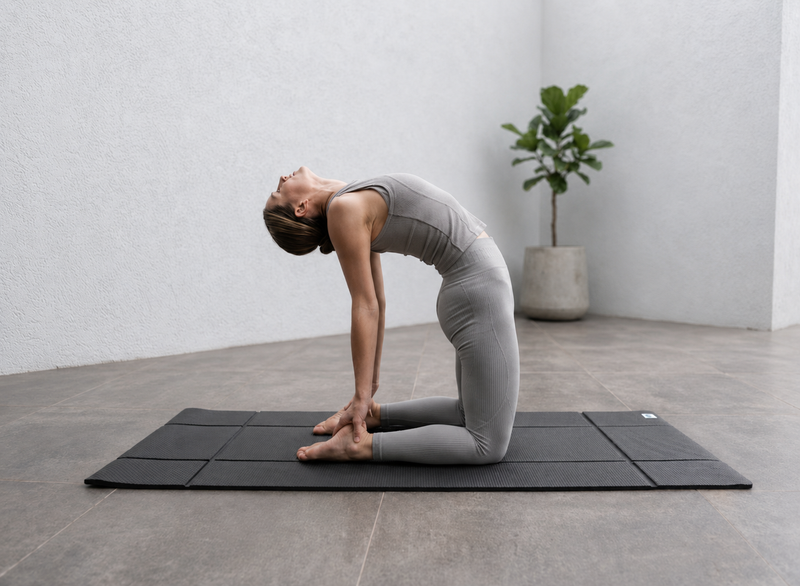
Fold it under your tailbone
Flip the far flap up for seated forward folds, bridge and supine twists. Lifting the base of the spine lets the hips release instead of bracing against the floor.